
Share John Richard Dolny's obituary with others.
Invite friends and family to read the obituary and add memories.
Stay updated
We'll notify you when service details or new memories are added.
You're now following this obituary
We'll email you when there are updates.
Select your format and elements to print

IN LOVING MEMORY OF John Richard Dolny
John Richard
Dolny
Feb 3, 1921 — Apr 13, 2020
Green Valley
John Richard Dolny's Obituary
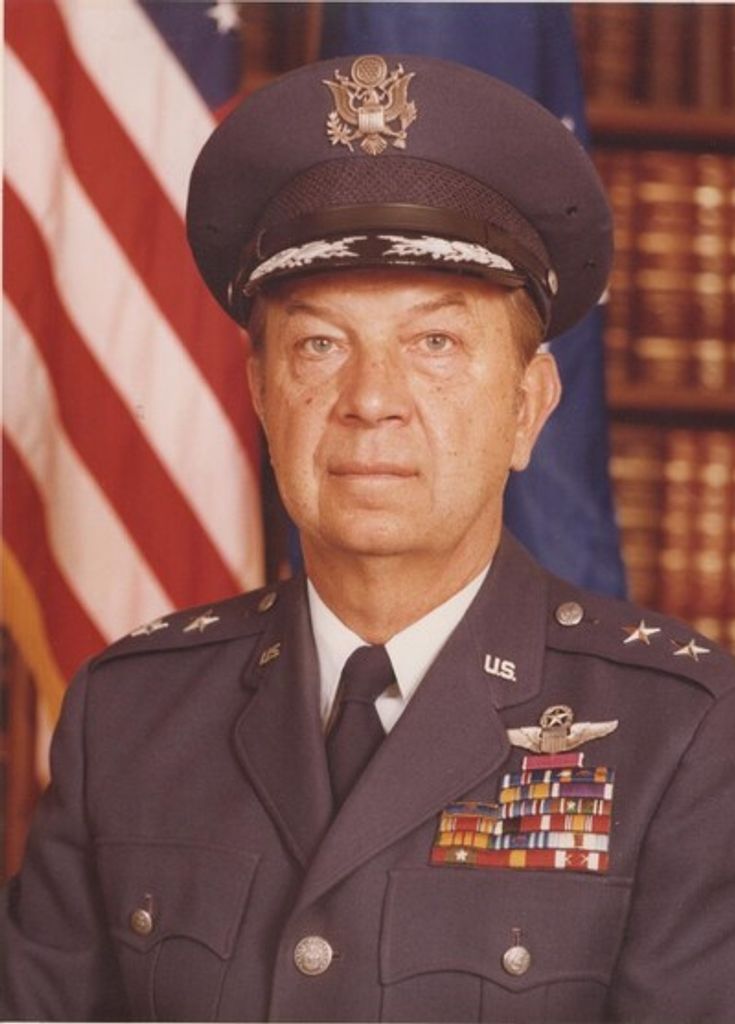
Air National Guard Leader Major General John R. Dolny, WWII Fighter Pilot, Wing Commander
John Richard Dolny, born Minneapolis 3 February 1921, died Monday April 13 in Tucson, Arizona at the age of 99.
John's early life was lived in Minneapolis, graduating from South High in 1938, then on to Dunwoody for mechanical drafting and machine design, graduating in 1940.
Following Pearl Harbor, John signed up in the Army Air Corps as a cadet, and received his wings and commission in February 1943. John was then shipped to North Africa, attached to the 525th Squadron of the 86th Fighter Group, which then in September moved over to Italy. John flew the A-36 fighter bomber version of the P-51 Mustang, and their mission was primarily low altitude ground attack and interdiction. In March 1944 while on a bombing run, his aircraft was hit with groundfire near Rome. He nursed it along back to the west and bailed out just over the friendly side of the battlefront, receiving some leg injuries in landing.
As his combat tour was up he could have returned stateside for rest and recuperation, but he voluntarily extended for another tour and was rewarded with command of the 527th Fighter Bomber Squadron at the age of twenty three. The 527th had about twenty four aircraft, thirty five pilots and 300 officer and enlisted support personnel.
As attrition reduced the number of A-36 aircraft available, John's squadron converted to the P-40 for a short time, then received the much larger, more powerful P-47 Thunderbolt. As a prerogative of squadron commanders he could paint nose art on his airplane, which he named for his niece, Sandra Lee .
As the war progressed, his squadron moved from Orbetello, Italy to Corsica for the southern France invasion; then to Pisa, Italy to cover the northern Italy campaign. In December 1944 he moved the 527th to Tantoville, France to participate in the final push into Germany then finally to Gross Gerau, Germany as the war ended. Major Dolny completed 135 combat missions and was awarded the Distinguished Flying Cross, Air Medal with clusters, Purple Heart, Bronze Star, and French Croix de Guerre with silver star.
After a short stateside rest and recuperation, John returned to Germany in February 1946 as Deputy Commander of the 64th Fighter Wing, responsible for closing down military bases and disposing of aircraft. Sadly, he witnessed the destruction of his beloved Sandra Lee among piles of aircraft that were bulldozed.
In September 1946 John returned home and separated from the Army Air Corps as a Lieutenant Colonel. John worked briefly for Honeywell as a draftsman, then in March 1947 as the National Guard was reconstituting its flying units, John signed up and became the 109th Fighter Interceptor Squadron commander, which flew F-51 Mustangs, and various other support aircraft, out of Holman Field, now the St Paul Downtown Airport.
In 1950 he was promoted to full Colonel at the age of 29, and took command of the 133rd Fighter Interceptor Group, the parent organization of the 109th. The 133rd was called to active duty for the Korean War in March of 1951 for 21 months of active service, mostly at home station.
Returning to traditional Guard status, John commanded the newly established 133rd Air Defense Wing, which was comprised of four ANG Groups; St Paul, Duluth, Fargo ND, and Sioux Falls SD. These units continued to fly the F-51 Mustang until jet fighters became available from the active Air Force. F-94 and F-89 interceptors came into the units, which then stood 24/7 alert protecting the nation's northern border. With the new jet fighter mission, in 1958 the 133rd moved from St Paul's Holman Field to Wold Chamberlain Field (now Mpls-St Paul IAP) and took over the active duty air defense mission.
John was the leader of the Air National Guard effort to get a heavy airlift mission from the Air Force, and in January 1960 the 133rd received the four engine C-97 heavy transport. With this conversion, the 133rd became the lead Air Transport Wing in the Air National Guard with subordinate units in Providence RI, Schenectady NY, Mansfield OH, and New Castle DE.
John was promoted to Brigadier General in 1961. In October, the Wing was called to active duty for eleven months in support of the Berlin Crisis. The mission was worldwide airlift, and our aircraft were heavily involved in European Theater logistics. After deactivation, the 133rd continued its airlift mission, becoming much more involved in Southeast Asia as the Vietnam War heated up.
In 1970 the 133rd was redesignated as a Tactical Airlift Wing, and converted to the C-130 Hercules, the same mission that the Wing flies today, fifty years later, albeit with much newer C-130s. John continued as the Wing Commander until 1977, when he was promoted into his new position as ANG Special Assistant to the Commander, Air Defense Command (ADCOM) , and received his second star to Major General. John served to provide liaison between ADCOM and the many Air National Guard air interceptor units around the country. John retired at age 60 in 1981 with 39 years of service.
Major General Dolny had over 10,000 hours as a command pilot, with 135 combat missions and 211 combat hours. He flew the A-36 Apache, P-40 Warhawk, P-47 Thunderbolt, F-51 Mustang, F-94 Starfire, F-89 Scorpion, C-97 Stratofreighter, and C-130 Hercules aircraft.
In recognition of his long, distinguished service to his nation and the state of Minnesota, John was inducted into the Minnesota Aviation Hall of Fame in 1998.
During John's Air National Guard career, he lived in West St Paul. After retirement, John built a summer home at Voyager Village, WI, and had a winter home in Green Valley, AZ.
John was the sixth of nine siblings (John, Edward, Len, Ray, Bill, Betty, Ann, Andy, and Dorothy) born to Czech immigrant parents, who lived in the ethnic shanty community of Bohemian Flats, which is now parkland under the Washington Avenue bridge.
General Dolny was predeceased by his first wife Ida Mae, six siblings, and survived by his wife Gisela, his son Keith, daughter Patricia, five grandchildren (Bob, Angie, Sheryl, Robert, and Jennifer) , and five great grandchildren (Allison, Nathan, Noa, Serena, and Hailey) . He is also survived by two brothers; Raymond and wife Deloris, and brother Leonard and wife Harriet.
Quite typical of the common family connections within the Air National Guard, three of John's brothers were also members of the 133rd. Edward was killed in an aircraft crash while in pilot training in 1949, Raymond served in maintenance, and Leonard as a pilot. They subsequently continued careers as airline pilots.
John was known and respected by his subordinates as a quiet, but confident and firm natural leader. Hewed out of his young experiences as a wartime squadron commander, John was comfortable with, and treated everyone from young enlisted, officers, generals and governors with great respect. John always sought to mentor his young future leaders, grooming them and showing them the ropes to get their careers off to the right start.
In his retirement years, John Dolny enjoyed tennis, golfing well into his nineties, family outings and traveling the United States and Europe. He will be greatly missed by family, friends and people that knew him.
A museum display that memorializes John's career and contributions, and preserves his memorabilia, is located at the Minnesota Air National Guard museum, located at the base at the Minneapolis-St Paul Airport.
Memorials are preferred to the Minnesota Air National Guard Museum ( mnangmuseum.org ).
A Funeral Service and Interment with Honors at Fort Snelling National Cemetery Minneapolis, MN will be scheduled when the COVID - 19 restrictions are removed and safe to do so. Information will be published in an obituary and this website.
Funeral Services for John Richard Dolny
Visitation

Friday
St. Stephen's Lutheran Church
10:00 - 11:00 am
Memorial Service
Friday
St. Stephen's Lutheran Church
11:00 am - 12:00 pm
Graveside
Friday
Fort Snelling National Cemetery
1:30 - 2:00 pm
John Richard Dolny's Guestbook
Visits: 26
This site is protected by reCAPTCHA and the
Google Privacy Policy and Terms of Service apply.
Service map data © OpenStreetMap contributors